Beyond the dashboard: start with the decision, not the data
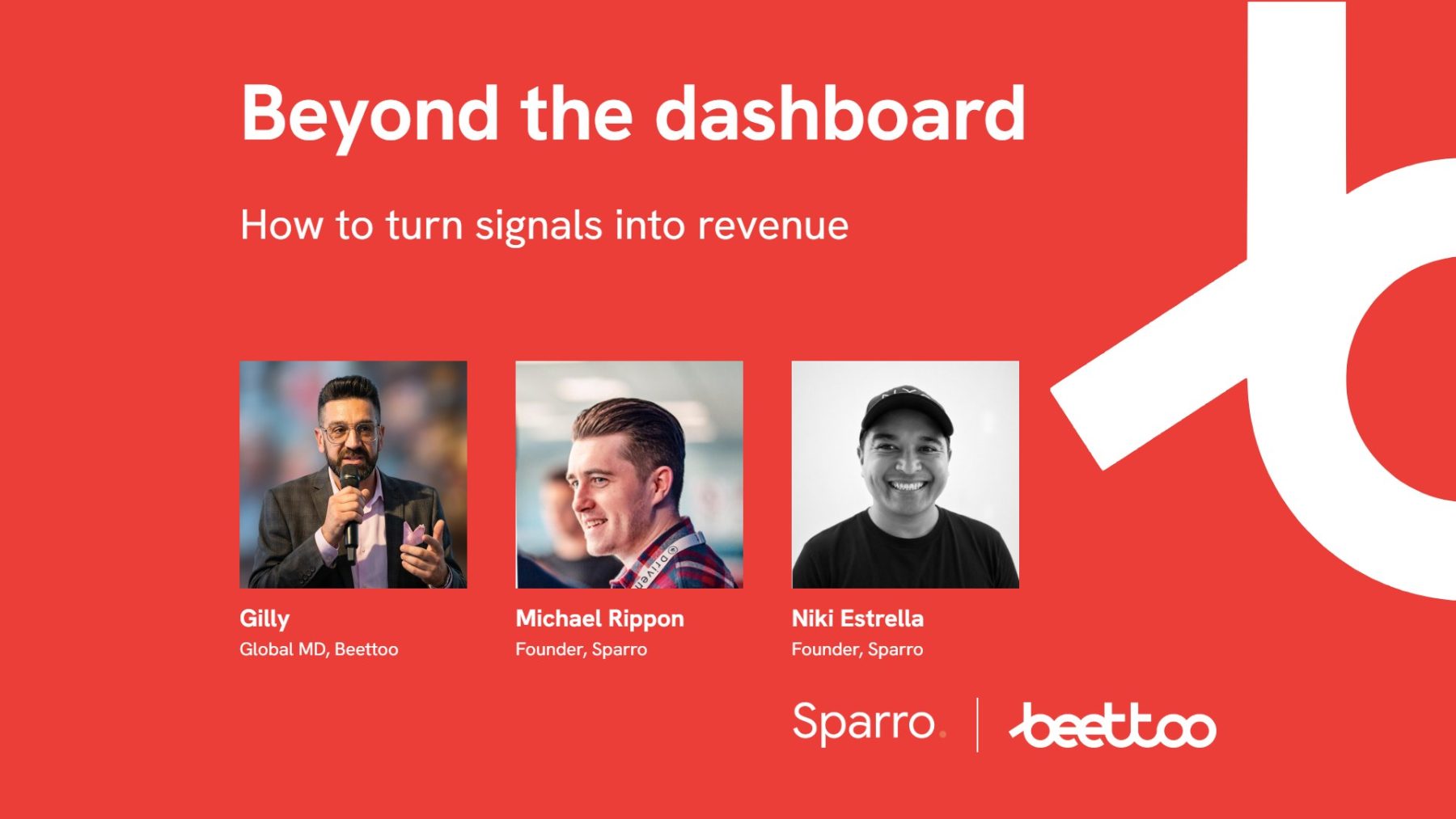
Most B2B marketing teams aren’t short of data. They’re short of answers. In our latest webinar, James “Gilly” Gill, Global Managing Director at beettoo, spoke with Michael Rippon and Niki Estrella, Co-Founders of Sparro, about why traditional data-driven approaches keep letting teams down, and what to do instead.
Collect everything, just in case
The most common data strategy Sparro still sees is “collect everything from everyone just in case”. It sounds sensible: more data should mean better models and better answers. In practice, this approach mostly creates noise and cost.
Part of the problem is how easy collection has become. As Niki put it, an AI assistant could set up Google Analytics on your website in half an hour, “but that doesn’t necessarily mean that’s any kind of strategy.”
The result is dashboards stuffed with metrics that make decisions harder, not easier. Niki was clear that dashboards aren’t dead, despite what the LinkedIn headlines say. Most were simply built before anyone agreed on which decision they should support.
His test is simple: If I give you this number, what will you do differently? If the answer is nothing, it shouldn’t be there.
The most useful thing Sparro often does with a client dashboard is remove metrics. If you only need to know whether a campaign is working, a clear red or green signal may be enough, rather than multiple metrics.
Gilly framed the cost of a “collect everything” approach. Buyers spend more of their journey out of sight (in the Dark Funnel) before they fill in a form or speak to sales, and only 26% of businesses have most or all of their martech stack integrated, according to Clevertouch’s State of Martech 2026 research. So teams put effort into vanity metrics inside individual platforms, while the signals that matter go unread. The line often attributed to Einstein still applies: not everything that can be counted counts.
Swap the audit for a brief
When something looks wrong, the instinct is to ask for an analytics audit. Michael’s view is that an audit is a checklist. It confirms your setup works as intended and leaves you compliant, but on its own it rarely moves the needle.
With CMOs, he starts somewhere else:
- What decision are you trying to make?
- Which numbers drive that decision?
- Where do those numbers come from?
- Where does it fall apart?
- What does it cost when it falls apart?
These questions turn “something’s wrong with our tracking” into a brief tied to what leadership cares about. Leaders can see the problem in the numbers they report, so they can take steps to fix it.
Michael suggests one more reframe: treat the foundational work as AI readiness. Many B2B businesses are investing heavily in AI, and an AI agent is only as trustworthy as the data beneath it. That makes data investments easier to fund.
Niki’s version of the same idea is to treat analytics like product development. Before building a product, you ask who the user is and what problem it solves. A dashboard deserves the same brief. “We need to know this campaign is working” isn’t the answer, because it produces dashboards filled with everything.
Sparro groups the decisions data should support into four levels of intelligence:
| Level | The question it answers |
|---|---|
| Commercial intelligence | Where should we invest time and focus to grow? |
| Audience intelligence | Who should we target? |
| Channel, content and context intelligence | Where, when and how should we show up? |
| UX, CRO and experience intelligence | What should we build and improve? |
If a dashboard, experiment or new tracking event can’t be linked to a decision in one of these areas, Sparro doesn’t recommend building it.
Get the basics right before the shiny stuff
Michael and Niki agreed that the most common failures they find in 2026 are still basic ones.
- Inconsistent campaign tracking. Michael sees it in almost every setup: no consistent way of tagging media campaigns. That breaks attribution and makes it hard to connect activity to revenue. The fix is usually governance and agreed definitions, not another tool.
- Misread direct traffic. “Direct” or “unassigned” visits often aren’t people typing in your URL. Niki pointed out they can be missing UTM parameters, or an AI assistant stripping the referrer before sending someone to your site.
- Dirty data. Duplicates and missing values muddy every analysis. In Niki’s words, “if you put rubbish in, you get rubbish out.” Time spent cleaning data pays back at the analysis stage.
- Disconnected accounts. In B2B, several people from one firm may visit at different times, from different places, looking for the same answer. Enrichment ties those visits to the account, so you see a firm’s interest rather than scattered sessions.
Agree what your numbers mean
Many businesses think they have shared definitions when they don’t. A glossary helps, but Niki pointed out that a “user” in Meta isn’t the same as a user in GA4 or in organic search reporting. Ask “how many users did we have in Q2?” without agreed definitions and you’ll get a different answer each time.
Revenue is harder still. It could mean revenue tracked in analytics or ad platforms or in the CRM. It could mean signed customers, or customers reconciled after they’ve stayed a while. Pipeline can look like growth; money in the bank is harder to argue with. What matters is agreeing which number proves the business is growing, along with giving someone ownership of that definition.
Gilly added the familiar B2B version: lead, MQL, SQL, expression of interest, opted-in contact. Several labels for what may or may not be the same thing.
Definitions matter because targets shape behaviour. An SEO team measured only on rankings and traffic will optimise for traffic, even if that traffic never becomes revenue. And nobody wants to discuss bounce rates in a board meeting. The board wants year-on-year growth and evidence that marketing is bringing in customers who convert, stay and spend more.
Read the digital body language
Niki compared every event on a website to body language in a face-to-face sale. Someone reading an overview or watching a video is leaning in. Someone on the pricing page is leaning in further. Gilly called this “digital body language”: the trail of behaviour that shows how ready someone is (true first-party intent).
There are two types of signals worth acting on:
- Historic patterns. Models built on past customers show which combinations of actions, such as videos, pricing views, ebook downloads and webinar sign-ups, make someone more likely to convert.
- Real-time intent. Someone who goes straight to pricing and books a demo at 10 pm is showing different intent to someone browsing during the working day.
This matters more as AI overviews and zero-click search grow. More research happens without a visit to your site, so buyers often arrive later and with stronger intent. That makes the small steps before a demo request worth watching, not just the final conversion.
Timing is part of the signal. Niki used a car showroom metaphor: nobody browses one without a reason. Approach someone at the door with a deal and the answer is no. Wait until they’ve looked at the price and opened the car door, then offer help, and a test drive becomes a natural next step. Signals should tell you when to add value, not when to push.
Gilly linked this to relevance. Buyers want relevance more than hyper-personalisation, and relevance can come from what someone has done in the past week or month. First-party signals count for more here than third-party data, which your competitors can buy too.
Buying groups leave more than one trail
Nobody researches CRM platforms for fun. As Niki put it, there’s always an external trigger: an RFP, frustration with a current provider or a newly recognised problem. That usually sends several people looking at once.
Where consent allows, identity resolution joins the dots. An IP address linked to a company’s head office, then a webinar sign-up from the same email domain, starts to build a picture of one firm’s interest. CRM data and intent platforms such as 6sense further help to understand who is visiting, how senior they are and how often they return.
Different people in the buying group need different engagement. Procurement and technical evaluators ask about security, compliance and privacy policies. That can look like low interest, but it often means a deal is further along. Niki still sees blanket responses instead, such as a free trial offered to anyone who looks engaged.
Gilly gave another example. If a marketer evaluating CRM technology starts reading technical documentation or downloading a spec, they’re probably building the case for their IT team. That’s the moment to give them content for IT, procurement or finance, rather than content chosen by job title alone. It matters because many complex deals aren’t lost to a competitor. They stall and end in no decision.
Let retention power acquisition
Server-side tracking is usually sold as a fix for cookie loss and ad blockers. Michael warned that most teams simply copy their existing setup to the server and count the extra signals as success.
The bigger opportunity is connecting these signals to what happens after the conversion. Linked to your CRM or billing system, server-side tracking can tell ad platforms when a deal closes or a customer cancels. If you bid for people who sign up and leave after three months, you grow conversions without growing the business. Feed back lifetime value instead, and the platforms can find more customers who stay.
Niki raised the organisational side. Acquisition teams celebrate at the point of sale, retention teams own what happens next, and the two rarely talk. Gilly compared it to the bowtie model in ABM, where the journey continues into adoption, renewal and advocacy. As Michael put it: “You’ve got to know what’s happening in retention to power your acquisition.”
Put AI on solid foundations
Conversational analytics is appealing because anyone can ask a question in plain language. Niki’s concern is how teams get there. Connecting an AI assistant straight to a data warehouse and asking how many users you had last week amplifies every existing problem. There are no guardrails, no evaluations and no agreed definitions. And because these models are non-deterministic, you may get a different answer each time.
He described three layers to put in place first:
- Data layer: data collected, stored and transformed so it’s usable.
- Information layer: what each metric means, plus the business context for why it matters.
- Workflow layer: documented procedures that tell an AI which source, connection and definition to use for a given question.
Gilly argued that AI needs a human-in-the-lead, not just in-the-loop. Three years of historical data may describe a buying journey that no longer exists, and someone has to decide which metrics matter now. He also suggested the AI features built into established analytics platforms may be the more sensible option for many teams today, given the gap between the noise on social media and what’s working in practice.
Where to start
Both guests closed with the same message from different angles.
- Start with the decision, not the data. Niki recommends working out what you need to know before deciding what to collect. The decision tells you which data you need.
- Stop thinking tool first. Michael compared it to buying a new drill and looking for something to drill. When a tool doesn’t shift the numbers, teams try another one and the hole gets deeper. What’s usually missing is the strategy, and bringing people along so the data actually gets used.
Four practical steps for this quarter:
- List the decisions your leadership team will make over the next two quarters.
- Check which of them your current data can answer with confidence.
- Write a one-page brief for the biggest gap: who it’s for, the decision it serves and what good looks like.
- Agree, and assign an owner for, the definitions of the few metrics that go in front of the board.
Watch the full webinar
The full conversation runs around 50 minutes. It goes further into server-side tracking, buying group signals and what it takes to make AI analytics trustworthy.
About Sparro. Sparro helps brands harness their data to reach the right customers and build experiences that keep them coming back. wearesparro.com
Working out which decisions your data needs to support? We’d be happy to talk it through. Email [email protected]